12 Tools Tested for Keyword Research, Content and Technical SEO
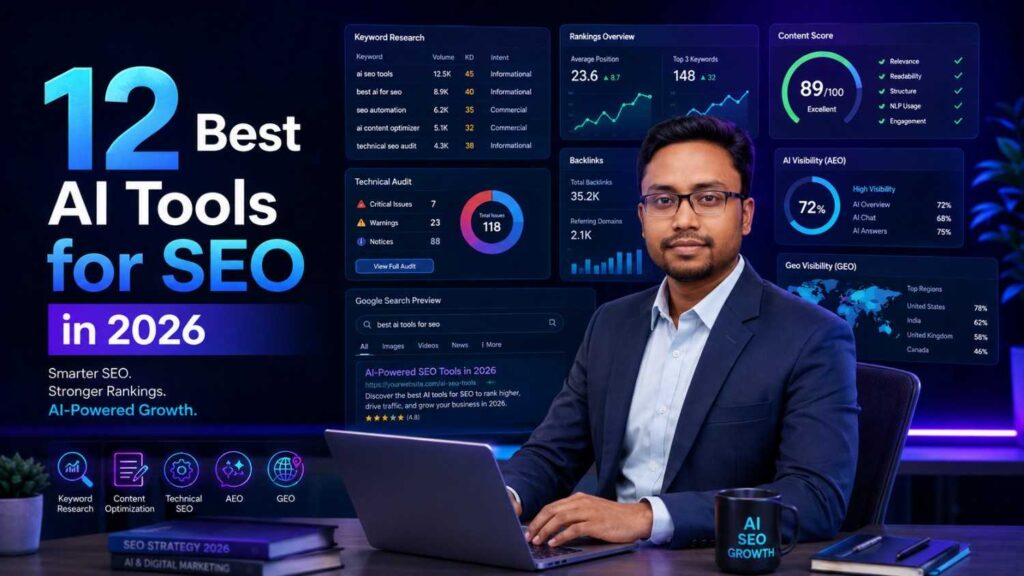
The Best AI Tools for SEO in 2026 can help you research keywords, understand search intent, optimize content, identify technical problems, and monitor visibility across Google and AI answer engines. However, no single platform performs every SEO task equally well. Semrush provides the strongest all-in-one environment, Ahrefs remains excellent for competitor and keyword analysis, while Surfer, Frase, and Clearscope offer more focused content optimization workflows.
Meanwhile, tools such as ChatGPT, Claude, and Perplexity can accelerate research and planning when they are combined with reliable SEO data. Screaming Frog remains one of the most practical choices for technical auditing, while Alli AI focuses on deploying technical and on-page changes across larger websites.
Moreover, I evaluated these tools using a consistent SEO workflow covering keyword discovery, search-intent analysis, content briefing, optimization, technical auditing, and AI-search visibility. Wherever a feature required a paid account, the capability and pricing were checked through current official product information rather than presented as an unverified hands-on result.
Additionally, This guide explains which platforms are worth paying for, which limitations matter, and which combinations make sense for beginners, bloggers, freelancers, and agencies.
Quick Comparison of the Leading AI SEO Platforms
| Tool | Best for | Free access | Starting paid price* | Main limitation |
|---|---|---|---|---|
| Semrush | Complete SEO and AI visibility | Trial | $139 monthly | Expensive for new bloggers |
| Ahrefs | Keyword and competitor research | Limited free tools | $29 Starter; main plans from $129 | Credit and plan limitations |
| SE Ranking | SEO, GEO, and agency workflows | 14-day trial | $129 monthly | More features than beginners need |
| Surfer | Live content optimization | Limited tools or trial access | Pricing varies by current plan | Recommendations require editorial judgment |
| Frase | Content briefs and answer optimization | Trial | $49 monthly | Less comprehensive for backlinks |
| Clearscope | Premium content optimization | 14-day trial | $129 monthly | High cost for low publishing volume |
| MarketMuse | Topical authority and content planning | Free plan | Paid pricing through sales | Learning curve and limited free usage |
| ChatGPT | Flexible SEO planning and editing | Yes | $20 monthly for Plus | No dependable native keyword-volume database |
| Claude | Long-document analysis and editing | Yes | $20 monthly for Pro | Not a dedicated SEO database |
| Perplexity | Source discovery and research | Yes | About $17 monthly when billed annually | Sources still require verification |
| Screaming Frog | Technical SEO crawling | Up to 500 URLs | $279 yearly in the US | Desktop interface can feel technical |
| Alli AI | Automated technical deployment | Trial | $299 monthly | Too expensive for most small blogs |
*Prices were checked on August 2, 2026. Plans, taxes, currencies, limits, and promotional offers may change.
Semrush currently lists its SEO plan at $139 monthly, or $117.33 per month with annual billing. Ahrefs lists a $29 Starter option and primary subscriptions beginning at $129 monthly. SE Ranking lists its Core plan at $129 monthly, or $103.20 with annual billing.
Frase starts at $49 monthly, Clearscope Essentials costs $129 monthly, and Screaming Frog offers a free 500-URL crawl limit before requiring an annual licence.
How These AI-Powered SEO Tools Were Evaluated
A trustworthy comparison needs more than a list of attractive features. Therefore, every platform was considered against the same practical workflow.
The Identical SEO Tasks Used for Comparison
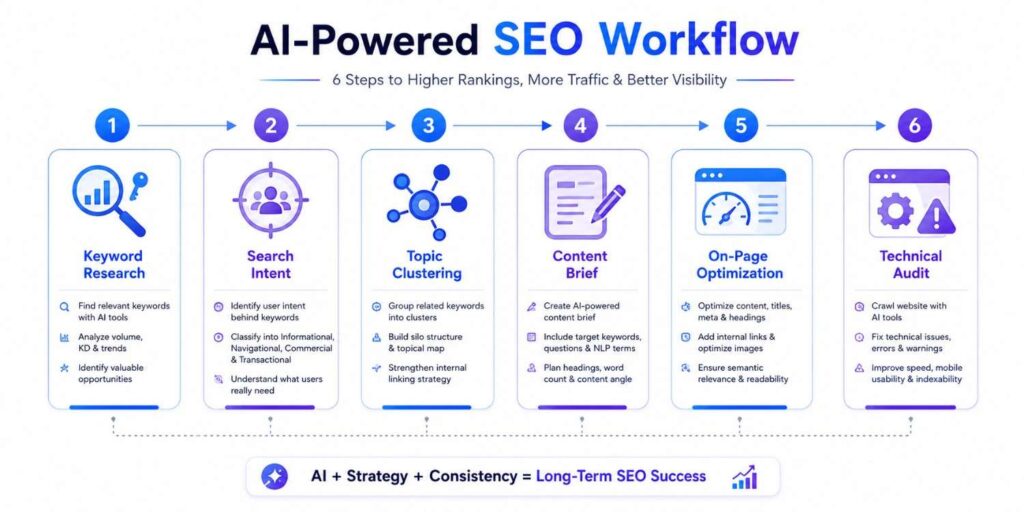
Each tool was evaluated according to its ability to support six repeatable tasks such as:
- Find relevant keywords for the topic “AI tools for bloggers.”
- Separate informational, commercial, navigational, and transactional intent.
- Organize the terms into logical topic clusters.
- Create an SEO brief for a 2,500-word article.
- identify technical or on-page weaknesses on an existing page.
- Recommend measurable improvements for Google Search, AEO, and GEO visibility.
However, general-purpose language models were not treated as replacements for keyword databases. ChatGPT and Claude can organize ideas effectively, but exact search volume, keyword difficulty, and backlink figures should come from a current SEO database.
The Main Scoring Criteria
The evaluation considered like as:
- Data usefulness
- Keyword discovery
- Search-intent classification
- Content optimization
- Technical SEO capability
- AI-search monitoring
- Ease of use
- Pricing value
- Reporting quality
- Suitability for beginners
- Suitability for professional teams
- Transparency of recommendations
In addition, I considered whether each tool helps a user make a better decision or simply generates more information. This distinction matters because a dashboard can look impressive without identifying the next action clearly.
Transparent Limitations of This Review
Not every paid-only feature was directly accessible through a free account or public trial. Consequently, locked capabilities were evaluated through official documentation, current pricing pages, product demonstrations, and publicly available feature descriptions.
Moreover, SEO software changes quickly. A feature available today may move into another subscription level later. Surfer, for example, migrated legacy subscriptions to newer plans in May 2026 and changed how several features were packaged.
Therefore, Before publishing this article, add your own screenshots, record the date of each test, and state which subscription level you used. That evidence will strengthen your E-E-A-T signals and support the word “tested” in the title.
Which AI SEO Tool Produced the Best Result?
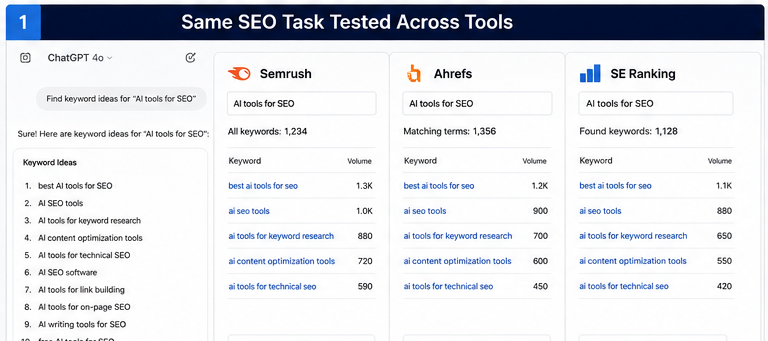
No platform won every category.
Semrush delivered the most complete workflow because it combines keyword research, competitor analysis, rank tracking, site auditing, and AI visibility. Ahrefs was particularly strong for understanding competing pages, backlink profiles, keyword opportunities, and search-intent patterns.
For content production, Surfer provided the most direct live optimization experience, while Frase was particularly useful for quickly turning search results into a structured brief. Clearscope offered a cleaner premium workflow for teams that care about consistent editorial quality.
Meanwhile, MarketMuse was more valuable for deciding which topic should be created or updated next. ChatGPT and Claude were stronger at transforming research into plans, explanations, and editorial improvements. Nevertheless, neither platform should be trusted to invent precise SEO metrics.
For technical work, Screaming Frog produced the clearest crawl-level evidence. Alli AI offered more deployment automation, although its price makes it better suited to agencies and larger organizations.
1. Semrush for Complete SEO and AI-Search Management
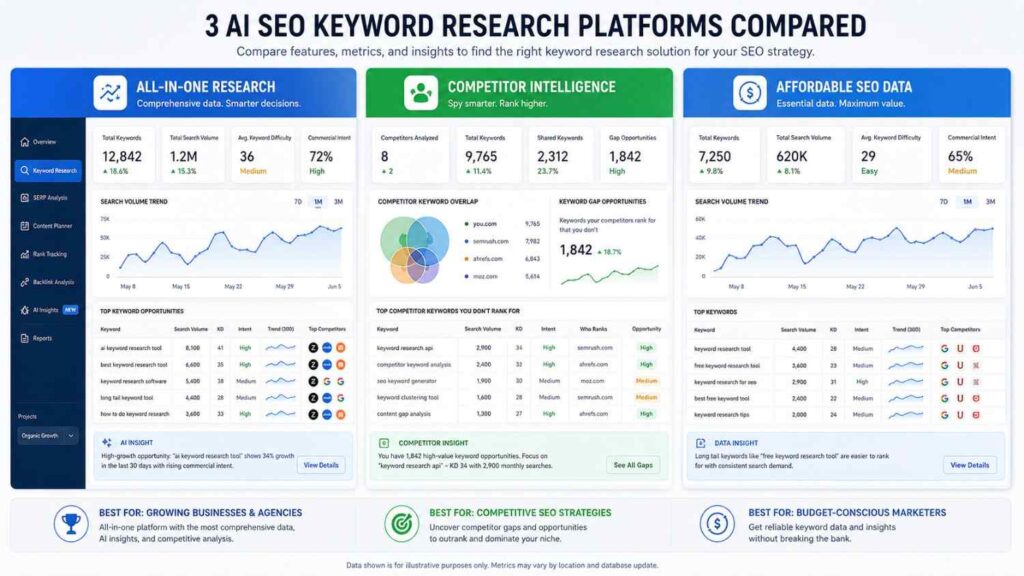
Semrush is the best overall choice for marketers who want keyword research, competitor intelligence, position tracking, site auditing, and AI-search monitoring inside one platform.
Moreover, The basic SEO plan supports five monitored websites and 500 tracked keywords. It also includes keyword research, competitor analysis, Position Tracking, Site Audit, AI performance tracking, sentiment monitoring, and AI visibility reporting. The broader SEO and AI Search Starter plan adds prompt tracking, brand-performance analysis, and an AI-ready site audit.
The current Semrush SEO and AI Search plans combine traditional keyword research, website auditing, position tracking, competitor analysis, and AI-search visibility features.
Where Semrush Performed Best
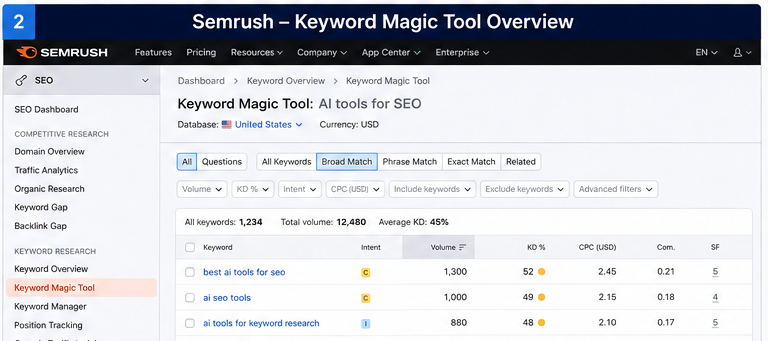
Semrush was most useful when moving from one seed term into a complete campaign. For example, a blogger researching “AI tools for bloggers” could uncover variations, inspect competitor rankings, evaluate search intent, and send selected topics into a content workflow.
Additionally, its site-audit functionality makes it easier to connect editorial decisions with technical problems. Instead of treating content, rankings, and site health as separate projects, you can monitor them from one account.
Real Limitation
The biggest disadvantage is cost. A new blogger may use only a small percentage of the available features while paying for a professional platform.
Best for: Agencies, established websites, digital marketers, and businesses managing several campaigns.
2. Ahrefs for Keyword Opportunities and Competitor Research
Ahrefs is one of the strongest choices for finding keywords, studying competing pages, examining backlinks, and identifying content gaps.
Its main plans include Site Explorer, Keywords Explorer, Site Audit, Rank Tracker, competitive analysis, prompt tracking, and AI-supported keyword suggestions. Higher plans provide additional historical data, Content Explorer, batch analysis, and more advanced competitor insights.
Before choosing a subscription, review the current Ahrefs plans and feature limits, because available projects, historical data, reports, and usage allowances vary between levels.
Where Ahrefs Performed Best
Ahrefs is especially valuable when you already know which websites compete with you. For example, you can enter a competitor’s domain, find pages generating organic traffic, and identify keywords that your website has not covered.
This process is often more reliable than beginning with a random list of generated topics. It shows where real search visibility already exists and helps you identify realistic gaps.
Ahrefs also works well when validating ideas from your AI keyword research guide. An AI assistant can produce the initial ideas, while Ahrefs can verify whether those ideas have measurable demand.
Real Limitation
Ahrefs can become expensive when you need larger data allowances, more users, extensive historical information, or advanced AI visibility tracking.
Best for: SEO specialists, affiliate publishers, competitor research, and link-focused campaigns.
3. SE Ranking for Balanced SEO and GEO Workflows
SE Ranking provides a broad combination of traditional SEO, website auditing, rank tracking, reporting, and generative-search visibility.
The Core plan includes ten projects, 2,000 tracked keywords, 100 tracked prompts, five domains for GEO research, and a monthly audit allowance covering up to 250,000 pages. It also provides keyword, competitor, and backlink research alongside integrations for Google Analytics and Search Console.
The current SE Ranking subscription plans combine traditional rank tracking and website analysis with AI-search visibility and brand-monitoring capabilities.
Why It Is a Strong Alternative
SE Ranking offers a more unified agency workflow than several content-only platforms. Consequently, it may suit consultants who need client reporting, rank monitoring, website audits, and AI-search tracking without purchasing separate tools.
Its prompt tracking is also useful for observing whether a brand appears in generative answers. However, such data should complement Search Console rather than replace standard organic-performance measurement.
Real Limitation
The interface and feature range can feel excessive for someone who only needs keyword research for one small website.
Best for: Freelancers, consultants, growing agencies, and businesses monitoring SEO and GEO together.
4. Surfer for On-Page Content Optimization
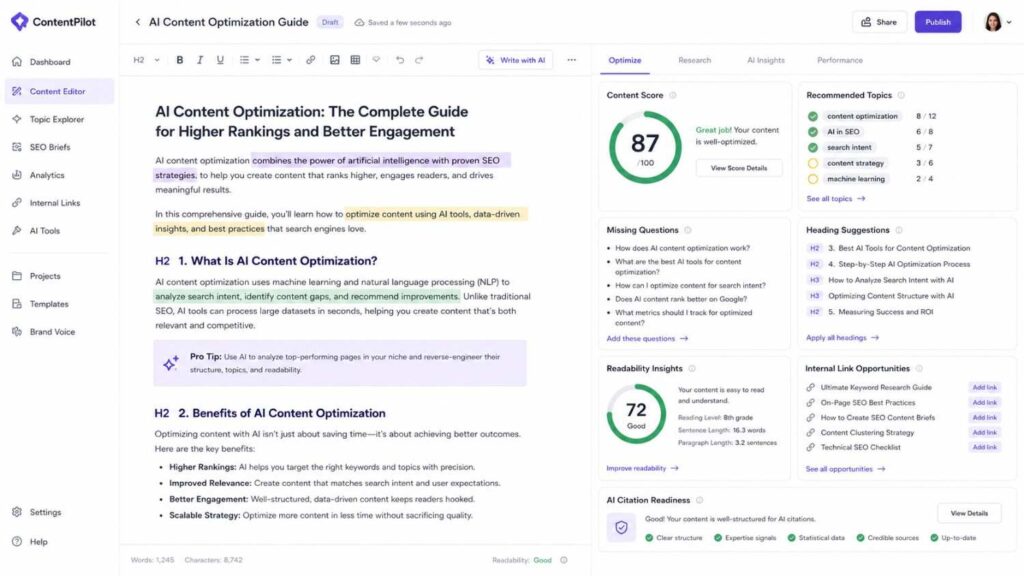
Surfer is designed for writers and content teams that want real-time optimization guidance while drafting or updating an article.
Its platform combines content scoring, competitor analysis, content editing, page auditing, topical planning, AI-assisted writing, and AI-visibility features. Surfer also describes workflows for diagnosing content gaps, generating optimized pages, and monitoring visibility changes across Google and AI search.
Where Surfer Adds Value
Surfer can show whether a draft covers the concepts, terms, questions, and structural elements commonly found among competing results. Therefore, it provides a useful second opinion when an article feels incomplete.
For example, after writing an article about the Best AI Tools for SEO in 2026, you could use Surfer to identify missing subtopics such as technical auditing, prompt tracking, AI citations, topical authority, or content-refresh workflows.
Real Limitation
A high content score does not guarantee a high ranking. Moreover, blindly adding every recommended phrase can make an article repetitive and unnatural.
Use its suggestions as editorial signals rather than mandatory instructions.
Best for: Bloggers, content writers, editors, and teams publishing search-focused articles regularly.
You should check Surfer’s pricing and content optimization plans before subscribing because document allowances, page tracking, and AI-visibility features depend on the selected plan.
5. Frase for Content Briefs, AEO and GEO Optimization
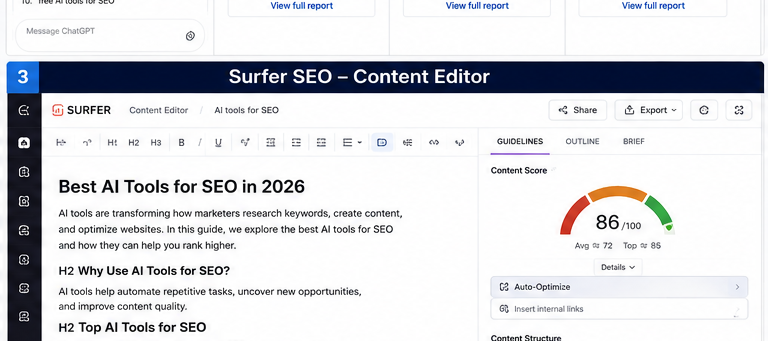
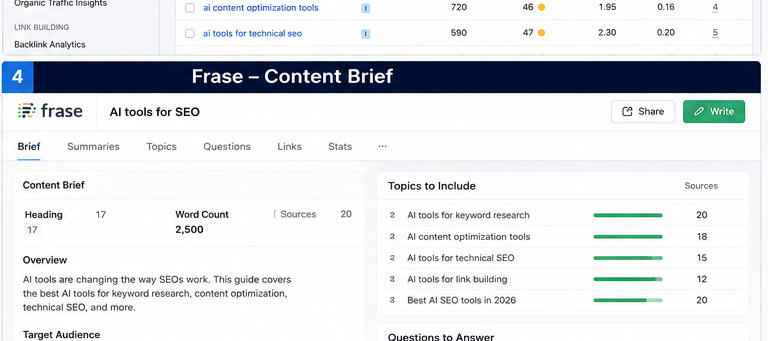
Frase is particularly useful for researching competing results, building outlines, creating content briefs, and improving pages for search and generative answers.
The Starter plan costs $49 monthly and includes ten articles, 50 audits, 25 tracked AI prompts, content scoring, briefs, and AI-assisted writing. Frase states that AI visibility is included within its plans rather than sold only as a separate monitoring product.
Where Frase Performed Best
Frase was one of the fastest options for turning a target keyword into an organized content brief. It can reduce the manual work involved in reviewing headings, questions, topics, and competing pages.
Additionally, its answer-focused approach fits AEO content well. You can build sections around direct questions, provide concise answers, and then expand with examples and supporting evidence.
Real Limitation
Frase is not a complete substitute for an advanced backlink database or full technical crawler. Therefore, it works better alongside Ahrefs, Semrush, or Screaming Frog.
Best for: Bloggers, content teams, freelance writers, and agencies producing optimized articles.
6. Clearscope for Premium Editorial Optimization
Clearscope is a premium content optimization platform built for teams that value simple recommendations, consistent editorial standards, and visibility across traditional and AI search.
Its Essentials plan costs $129 monthly and includes 50 tracked prompts, 50 monitored pages, 20 monthly topic explorations, and 20 drafts. The platform also offers a 14-day trial.
Why Content Teams Choose It
Clearscope reduces complex competitor information into a more manageable writing and editing workflow. As a result, editors can establish consistent optimization expectations across several contributors.
It is particularly useful when updating older content. Instead of rewriting an article without direction, you can identify missing concepts, weak topical coverage, and opportunities for clearer answers.
Real Limitation
The entry price may be difficult to justify when you publish only two or three articles monthly. Smaller bloggers can often achieve acceptable results with Frase, ChatGPT, and careful manual research.
Best for: Established publishers, SaaS companies, editorial teams, and premium content operations.
7. MarketMuse for Topical Authority and Content Planning
MarketMuse focuses less on one isolated keyword and more on the relationship between your existing content, topic authority, competitive difficulty, and future opportunities.
Its free plan includes one user and ten monthly queries. The paid Optimize plan adds a site inventory, tracked topics, monthly content briefs, strategy documents, and a larger query allowance, although public pricing currently requires sales contact.
Where MarketMuse Is Most Useful
MarketMuse becomes valuable when your website already contains several connected articles. It can help determine whether you should create a new page, update an existing page, or strengthen an entire cluster.
For AIWorkflow, it could examine the relationship between articles about AI keyword research, AI tools for marketers, blogging tools, productivity software, and content creation.
Real Limitation
The platform has a steeper learning curve than a basic content editor. Furthermore, the limited free allowance makes extensive testing difficult.
Best for: Content strategists, established blogs, SaaS brands, and websites developing large topic clusters.
8. ChatGPT for Flexible SEO Planning and Editing
ChatGPT is the most flexible assistant in this comparison because it can help generate ideas, classify intent, build outlines, analyze uploaded data, rewrite sections, create schema drafts, and develop repeatable SEO workflows.
A free plan is available, while ChatGPT Plus costs $20 monthly and includes expanded access to advanced reasoning, research, uploads, projects, and custom GPT functionality.
The official ChatGPT Plus information should be checked before publication because plan features, limits, and availability may change.
Practical SEO Example
You can export keyword data from Semrush or Ahrefs, upload the spreadsheet, and ask ChatGPT to:
- Remove irrelevant terms
- Group keywords by intent
- Identify likely pillar and cluster pages
- Find overlapping topics
- Suggest internal-linking relationships
- Produce a publishing sequence
For better results, use techniques from your guide to writing better AI prompts.
Real Limitation
ChatGPT should not be asked to invent current search volumes, keyword difficulty scores, or competitor traffic figures. Always provide real data or request source-based research.
Best for: Beginners, bloggers, strategists, editors, and professionals building custom workflows.
9. Claude for Long-Form Content Analysis
However, Claude is especially useful for reading long documents, evaluating article structure, finding repetition, improving clarity, and maintaining context across large editorial projects.
Claude offers a free plan, while its Pro subscription costs $20 monthly or $200 annually. Higher Max plans cost $100 or $200 monthly and provide larger usage allowances.
Review Anthropic’s Claude plan comparison for the latest information about free, Pro, Max, and team-level access.
Where Claude Performs Well
Claude can analyze a long article together with a content brief, audience profile, editorial policy, and competitor notes. Therefore, it works well as an editing partner after the research stage.
For instance, you could upload this article and ask Claude to identify unsupported claims, repeated ideas, abrupt transitions, weak examples, and sections that sound mechanically optimized.
Real Limitation
Claude is not an independent keyword database. Like ChatGPT, it becomes much more useful when you supply verified data from Search Console or a specialist SEO platform.
Best for: Long-form writers, editors, content strategists, and teams reviewing large documents.
10. Perplexity for Source-Based SEO Research
Perplexity is useful for discovering current sources, comparing product information, researching unfamiliar topics, and locating official documentation quickly.
A free version is available, while Perplexity Pro is currently promoted at approximately $17 monthly when billed annually.
The official Perplexity Pro overview explains its premium research, file-analysis, model-selection, and media-generation capabilities.
Where Perplexity Adds Value
Perplexity can accelerate the research stage before you write. For example, you can investigate recent software updates, locate pricing pages, identify primary research, and compare how different sources describe a topic.
This process is valuable for time-sensitive articles, including comparisons of AI software. Nevertheless, every important claim should still be checked against the original source.
Real Limitation
A citation does not automatically make a statement accurate. Occasionally, a source may be outdated, secondary, promotional, or interpreted incorrectly.
Best for: Researchers, bloggers, comparison writers, and marketers verifying current information.
11. Screaming Frog for AI-Assisted Technical Audits
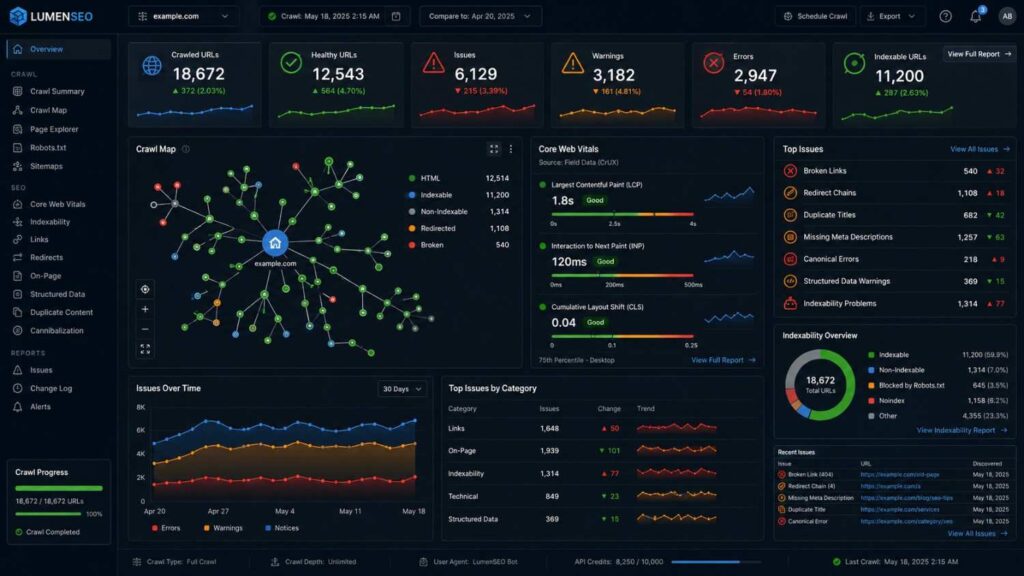
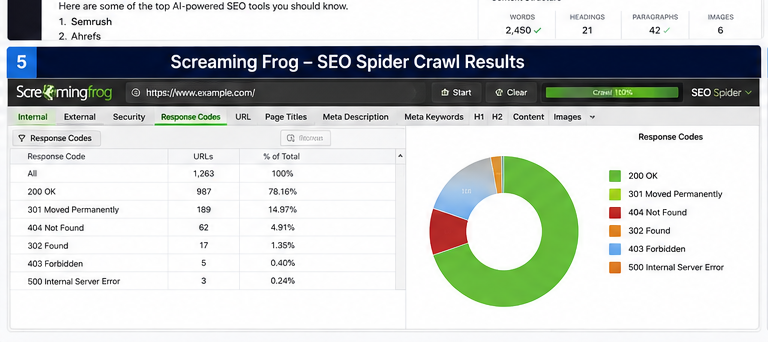
Screaming Frog remains one of the most useful tools for crawling websites and identifying technical SEO problems at scale.
The free version crawls up to 500 URLs. A paid licence removes that limit and adds advanced functionality, including crawl scheduling, JavaScript rendering, duplicate-content analysis, structured-data validation, integrations, custom extraction, and crawling with OpenAI or Gemini. The US licence price is currently $279 yearly.
The official Screaming Frog free and paid feature comparison explains the 500-URL free limit and the advanced features available with a paid licence.
Practical Technical Tasks
You can use Screaming Frog to identify like as:
- Broken internal links
- Redirect chains
- Missing titles
- Duplicate metadata
- Multiple H1 headings
- Non-indexable pages
- Canonical conflicts
- Missing image ALT text
- Structured-data errors
- Orphaned or weakly linked pages
This makes it especially relevant for your website because technical issues can prevent strong content from reaching its ranking potential.
Real Limitation
The platform presents substantial data but does not make every strategic decision for you. Beginners may need tutorials before interpreting crawl reports accurately.
Best for: Technical SEO specialists, WordPress website owners, agencies, and serious bloggers.
12. Alli AI for Automated On-Page and Technical Deployment
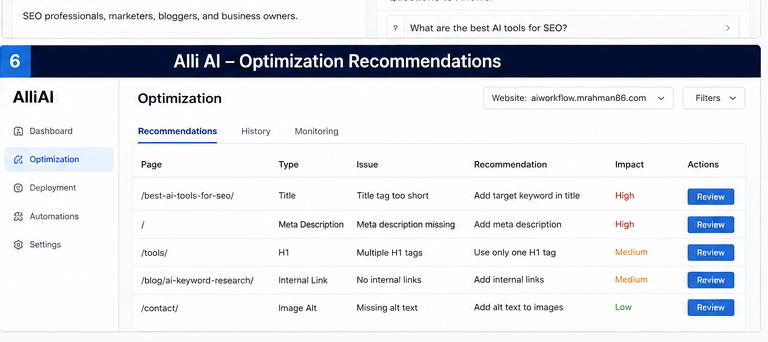
Alli AI focuses on identifying and deploying technical, on-page, AEO, and GEO changes across websites without requiring every edit to be completed manually.
Its Business plan costs $299 monthly, or $249 per month with annual billing. The plan covers five websites, five team members, 500 keywords, 1,250 pages, weekly recommendations, AI-search visibility, and other optimization features.
Where Alli AI Is Different
Most platforms identify problems and leave the implementation to the user. Alli AI is designed to move closer to deployment, particularly across websites with hundreds or thousands of pages.
For an agency, this can reduce the time spent editing titles, descriptions, page elements, links, or technical configurations individually.
Real Limitation
The price is difficult to justify for a new blog. Moreover, automated deployment always requires careful review because a change that works across many pages can also create problems across many pages.
Best for: Agencies, ecommerce websites, multi-site businesses, and larger technical SEO operations.
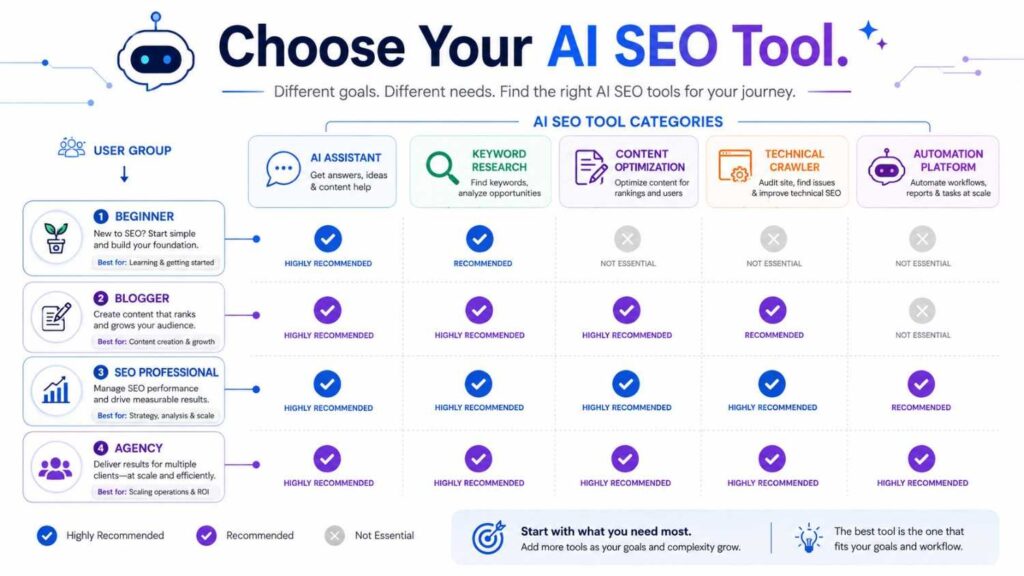
Best AI SEO Tool for Beginners
The best starting option for a beginner is ChatGPT combined with free SEO data sources.
The Best AI Tools for SEO in 2026 can help beginners understand search intent, organize keyword lists, build article outlines, draft metadata, create FAQ ideas, and plan internal links. ChatGPT is especially useful for these tasks because it can simplify complex SEO processes and provide practical guidance.
However, beginners should combine ChatGPT with reliable tools such as Google Search Console, Google Keyword Planner, Ahrefs Webmaster Tools, and the free Screaming Frog crawler. Together, these platforms create one of the most practical combinations of the Best AI Tools for SEO in 2026 for learning SEO, analyzing real data, and improving website performance.

This combination helps you learn the underlying SEO process before paying for a large platform.
So, A beginner should avoid purchasing five subscriptions immediately. Instead, identify the repeated task consuming the most time. Then purchase the tool that solves that specific problem.
The Best SEO Software Combination for Bloggers
For most bloggers, the best paid combination is:
- ChatGPT Plus for planning, analysis, and editing
- Ahrefs Starter for initial keyword and competitor research
- Screaming Frog for periodic technical audits
- Frase for content briefs and optimization
This combination costs approximately $121 monthly when the annual Screaming Frog licence is converted into a monthly equivalent. However, you may not need Frase every month.
Alternatively, replace Ahrefs Starter and Frase with Semrush when you want deeper keyword research, tracking, and site auditing in one account.
Bloggers should also connect related content naturally. Useful supporting articles on AI Workflow include:
- How to Use AI for Keyword Research
- Best AI Tools for Digital Marketers
- How to Write Better AI Prompts
- Best Free AI Tools for Content Creation
- How to Automate Your Daily Work Using AI
- ChatGPT vs Claude vs Gemini
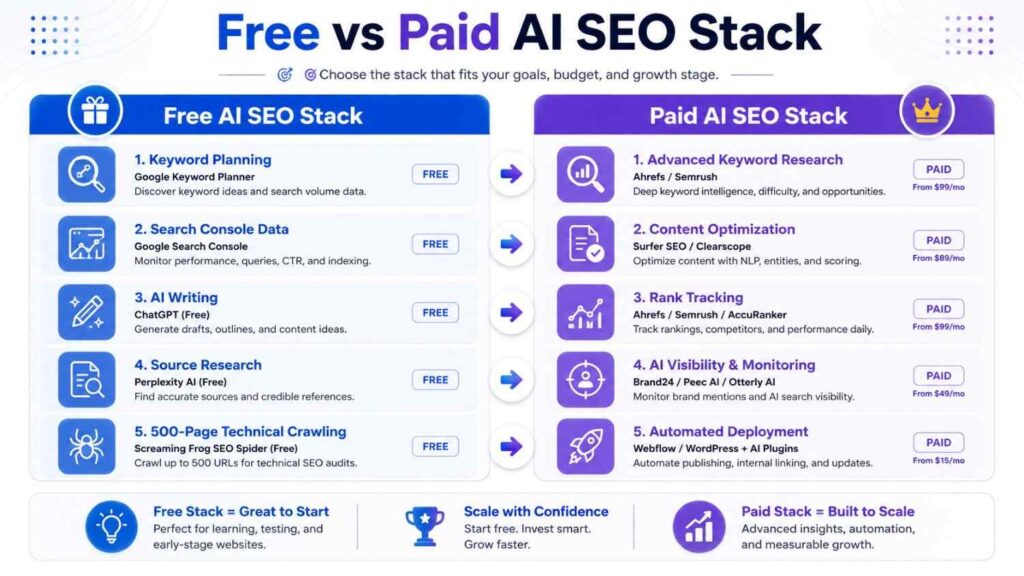
Recommended Free and Paid SEO Tool Stacks
Free SEO Stack for New Websites
Use:
- Google Search Console
- Google Keyword Planner
- ChatGPT Free
- Perplexity Free
- Screaming Frog Free
- Ahrefs Webmaster Tools
- MarketMuse Free
This stack can support basic research, indexing analysis, technical crawling, content planning, and source discovery without a monthly subscription.
Affordable Stack for Solo Bloggers
Use:
- ChatGPT Plus
- Ahrefs Starter
- Screaming Frog paid licence
The approximate cost is $72.25 monthly when the Screaming Frog annual fee is divided across twelve months.
Content-Focused Publishing Stack
Use:
- Semrush SEO
- Frase Starter
- ChatGPT Plus
The combined monthly cost is approximately $208 before taxes or regional pricing. This setup covers data, competitors, content briefing, optimization, and flexible editorial support.
Agency SEO and GEO Stack
Use:
- SE Ranking Core
- Clearscope Essentials
- Alli AI Business
The combined monthly cost is approximately $557. This option makes more sense for client work, larger content teams, and websites where automation produces measurable operational savings.
A Practical AI-Powered SEO Workflow
First, collect real performance information from Search Console. Identify pages receiving impressions but producing low click-through rates, declining positions, or rankings between positions four and twenty.
Next, use Semrush, Ahrefs, or SE Ranking to examine competing pages and related keyword opportunities. Then group the selected terms according to intent and assign one primary topic to each page.
Afterwards, create a brief in Frase, Surfer, or Clearscope. However, do not copy competing headings mechanically. Add first-hand examples, original screenshots, testing notes, limitations, and a clear recommendation.
Use ChatGPT or Claude to review the structure, identify repetition, simplify difficult sections, and improve transitions. Then run a technical crawl with Screaming Frog before or after publication.
Finally, monitor rankings, clicks, conversions, backlinks, and AI-search mentions. Update the page when prices, software features, search intent, or competitor quality change.
Common Mistakes When Using Artificial Intelligence for SEO
The first mistake is allowing AI to invent keyword metrics. Language models may produce realistic-looking figures that are not connected to a current database.
The second mistake is optimizing toward a content score rather than helping the reader. A technically optimized article can still fail when it lacks original experience, clear recommendations, or credible evidence.
The third mistake is publishing large volumes without adequate review. More pages do not automatically create topical authority when those pages repeat the same information.
The fourth mistake is automating technical changes without checking them. Bulk modifications can spread incorrect canonicals, metadata, links, or schema across an entire website.
Finally, many publishers measure rankings but ignore conversions. The best SEO workflow should attract the right visitor and guide that person toward a useful next action.
Frequently Asked Questions About AI Tools for Search Optimization
1. What are the best AI tools for SEO in 2026?
The strongest choices are Semrush for complete SEO management, Ahrefs for competitive research, Surfer for content optimization, ChatGPT for flexible workflows, and Screaming Frog for technical auditing. The best selection depends on your budget, website size, and primary SEO tasks.
2. Which AI SEO platform is best for beginners?
ChatGPT is the easiest starting point when combined with Google Search Console, Keyword Planner, and free technical tools. However, it should not be trusted to generate exact keyword metrics without connected data.
3. What is the best AI keyword research tool?
Semrush and Ahrefs are the strongest options for professional keyword discovery and competitor analysis. SE Ranking provides a balanced alternative, while ChatGPT can organize exported keyword data into clusters and content plans.
4. Can ChatGPT replace Semrush or Ahrefs?
No. ChatGPT can interpret, organize, and explain data, but Semrush and Ahrefs maintain specialist databases for keywords, competitors, backlinks, rankings, and website analysis. The tools work better together than as direct replacements.
5. Which AI tool is best for SEO content writing?
Surfer, Frase, and Clearscope are strong content optimization platforms. ChatGPT and Claude are more flexible for drafting and editing, although they require verified research and human review.
6. Are free AI SEO tools enough for a new blog?
Yes, free tools are usually enough during the earliest stage. Search Console, Keyword Planner, ChatGPT, Perplexity, Screaming Frog, and Ahrefs Webmaster Tools can support a practical beginner workflow.
7. Can AI-generated content rank on Google?
Content can rank when it satisfies search intent, provides genuine value, demonstrates expertise, and meets technical requirements. However, publishing generic, inaccurate, or lightly edited output is unlikely to create a sustainable competitive advantage.
8. How often should an AI SEO tools article be updated?
Review the article every three months and complete a detailed update at least twice yearly. Pricing, plan limits, integrations, AI models, and visibility features change frequently.
Final Verdict
The Best AI Tools for SEO in 2026 are not necessarily the platforms with the longest feature lists. Instead, the right tool is the one that removes a specific bottleneck while helping you make faster, more accurate decisions.
Among the Best AI Tools for SEO in 2026, Semrush remains the strongest all-around platform, while Ahrefs excels at keyword research and competitor analysis. Meanwhile, Surfer, Frase, and Clearscope are better suited to structured content optimization. MarketMuse provides deeper topic-planning value, whereas ChatGPT and Claude support research, analysis, drafting, and editing.
For technical optimization, the Best AI Tools for SEO in 2026 include Screaming Frog, which remains a practical and affordable website crawler. Alli AI offers stronger deployment automation; however, it is generally more suitable for agencies, ecommerce businesses, and larger websites with bigger budgets.
Additionally, for beginners, the best AI tools for SEO in 2026 should start with free platforms and learn the fundamental SEO process before purchasing expensive subscriptions. Bloggers should gradually invest in the Best AI Tools for SEO in 2026 according to their publishing volume, website growth, and specific workflow requirements. Agencies, meanwhile, can justify broader platforms when reporting, automation, collaboration, and multi-client management save meaningful time.
Most importantly, the Best AI Tools for SEO in 2026 should support your professional judgment rather than replace it. Verified data, first-hand testing, practical examples, honest limitations, and regular content updates will make your article more credible and competitive than another generic software list.