How to Write Better AI Prompts (Prompt Engineering Guide)
Basically, Artificial intelligence (AI) has changed how people write, research, code, design, and solve everyday problems. However, there is one factor that determines whether AI produces an excellent response or a disappointing one: the quality of your prompt. That’s why learning how to write better AI prompts has become an essential skill for anyone who wants to get the most from today’s AI tools.
However, Many people assume AI tools like ChatGPT, Claude, Gemini, or Microsoft Copilot simply “know” what they want. Unfortunately, that is rarely the case. Instead, AI works best when you provide clear instructions, relevant context, and a specific goal. Therefore, understanding how to write better AI prompts can dramatically improve the accuracy, relevance, and quality of every AI-generated response.
By the way, Whether you are a student, marketer, business owner, freelancer, or content creator, this prompt engineering guide will help you communicate more effectively with AI. More importantly, you will discover practical frameworks, real-world examples, and expert techniques that consistently produce better results.
By the end of this guide, you’ll know how to write better AI prompts with confidence and use AI more efficiently in your daily work.
Short Brief on Prompt Engineering?
Basically, Prompt engineering is the process of designing clear and detailed instructions that help AI understand exactly what you need.
So, Think of AI as an incredibly knowledgeable assistant. Nevertheless, even the smartest assistant cannot read your mind. Consequently, the more precise your request becomes, the more useful and relevant the response will be.
A prompt may include the followings:
- Background information
- The desired objective
- Output format
- Tone of voice
- Target audience
- Length requirements
- Constraints or limitations
For example:
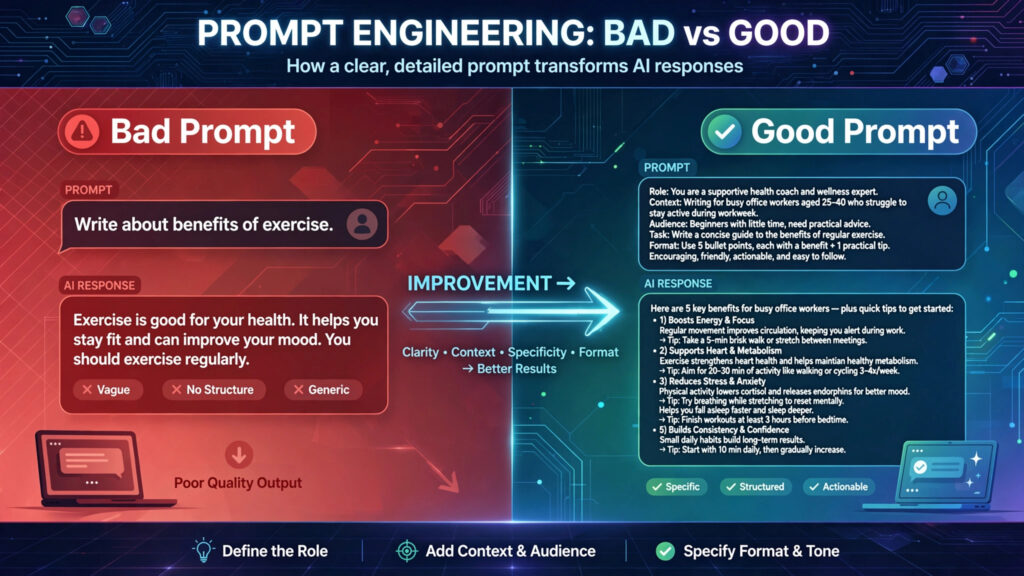
Weak Prompt
Write an article about SEO.
Strong Prompt
Write a 1,200-word beginner-friendly article about Technical SEO. Use H2 and H3 headings, include practical examples, maintain a conversational tone, optimize for the keyword “technical SEO checklist,” and end with an FAQ section.
Clearly, the second prompt provides direction, context, and expectations, making it much easier for AI to deliver quality content.
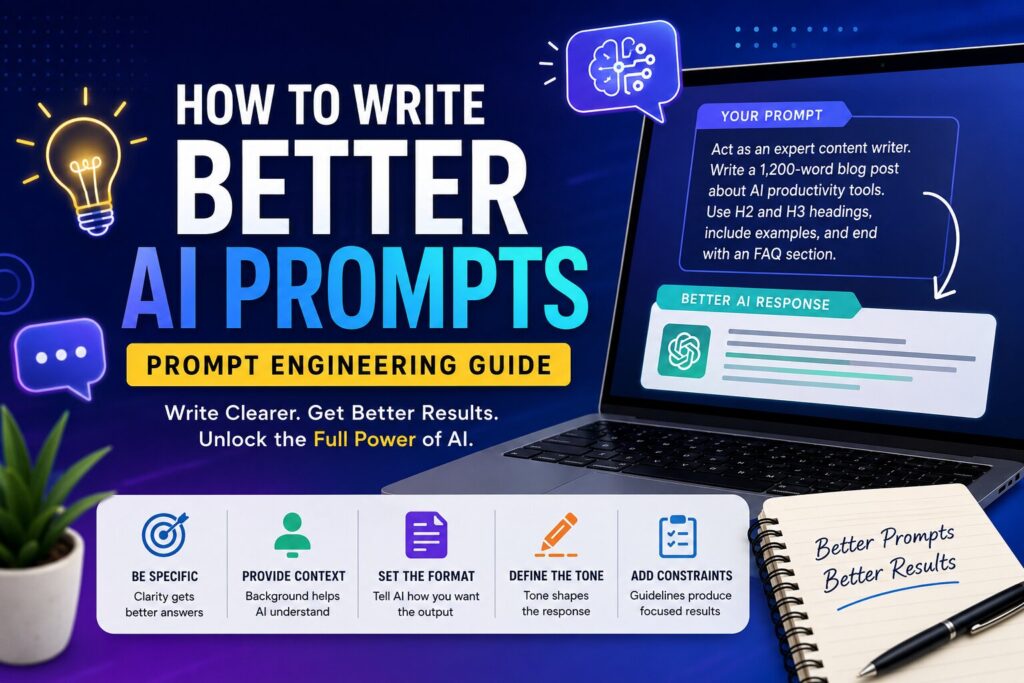
Learn Why Better AI Instructions Produce Better Results
Generally, The biggest difference between beginners and experienced AI users is not the AI tool itself. Rather, it is the quality of the instructions they provide.
Better prompts help you to get accurate result:
Get More Accurate Responses
In fact, Specific instructions reduce misunderstandings and produce more relevant answers.
Save Time
Instead of rewriting multiple times, you receive useful results on the first attempt.
Improve Content Quality
Detailed prompts encourage AI to generate structured, informative, and engaging content.
Increase Productivity
Whether you create blogs, emails, presentations, or reports, better prompts significantly reduce manual work.
As a result, prompt engineering has become an essential productivity skill across almost every industry.
The Five Elements of an Effective AI Prompt
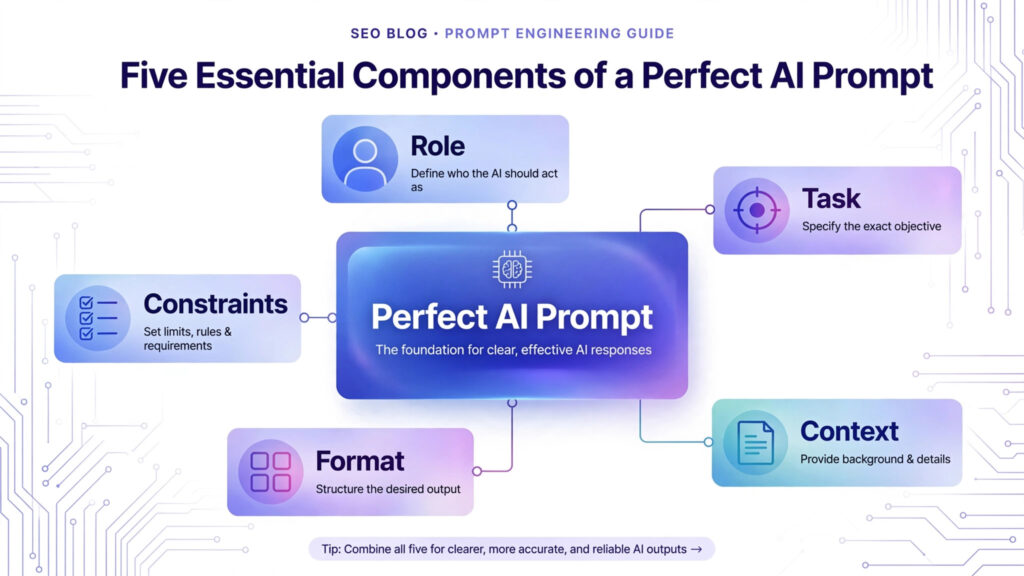
Whenever you write a prompt, include these essential components whenever possible.
1. Define the Goal
Firstly, explain exactly what you want.
Example:
Create a blog post explaining local SEO for small businesses.
2. Provide Context
Secondly, tell AI who the content is for.
Example:
The audience consists of beginners with no prior SEO knowledge.
3. Specify the Format
Then explain how the output should look.
Examples include:
- Blog post
- Checklist
- Table
- Presentation outline
- Social media caption
4. Set the Tone
Tone dramatically changes the final result.
Examples:
- Professional
- Friendly
- Persuasive
- Conversational
- Formal
- Technical
5. Add Constraints
Finally, define any limitations.
Examples:
- 1,000 words
- Bullet points
- Include FAQs
- Avoid technical jargon
- Use simple English
Finally, Combining all five elements creates prompts that consistently outperform vague requests.
A Practical Prompt Formula That Works Every Time
If you struggle to write prompts, use this simple framework:
Role + Task + Context + Format + Constraints
Example:
Role
You are an experienced SEO content strategist.
Task
Create a blog about email marketing.
Context
The audience is beginner bloggers.
Format
Use H2 and H3 headings, practical examples, FAQs, and a conclusion.
Constraints
Write 1,500 words using a conversational tone.
So, This framework works exceptionally well for blogging, marketing, education, business, and software development.
Real Examples of Good vs Bad Prompts
Learning from examples is one of the fastest ways to improve prompt writing.
Example 1: Content Writing
Poor Prompt
Write about AI.
Better Prompt
Write a 1,200-word article explaining how AI helps small businesses reduce costs. Include statistics, practical examples, and actionable tips.
Example 2: Email Writing
Poor Prompt
Write an email.
Better Prompt
Write a polite follow-up email after a job interview. Keep it under 150 words and maintain a professional tone.
Example 3: Social Media Post Creation
Poor Prompt
Create a Facebook post.
Better Prompt
Create an engaging Facebook post promoting an online SEO course. Include an attention-grabbing hook, benefits, and a call to action.
Notice that how each improved version provides purpose, audience, and expectations.
Most Common Prompt Engineering Mistakes to Avoid
However, even experienced users occasionally make these mistakes.
Being Too Vague
General requests usually generate generic answers.
Instead, provide specific instructions.
Asking Multiple Questions at Once
Avoid combining unrelated requests into one prompt.
Instead of asking:
Write a blog, create social posts, generate images, and design a logo.
Break them into separate tasks.
Forgetting the Target Audience
Content written for developers differs greatly from content written for beginners.
Always define your audience.
Ignoring Output Format
Additionally, if you need a table, make sure to ask for a table.
Similarly, when you require Markdown, clearly specify that you want the response in Markdown format.
Finally, if you need HTML, be sure to request HTML specifically to get the desired output format.
Accepting the First Response
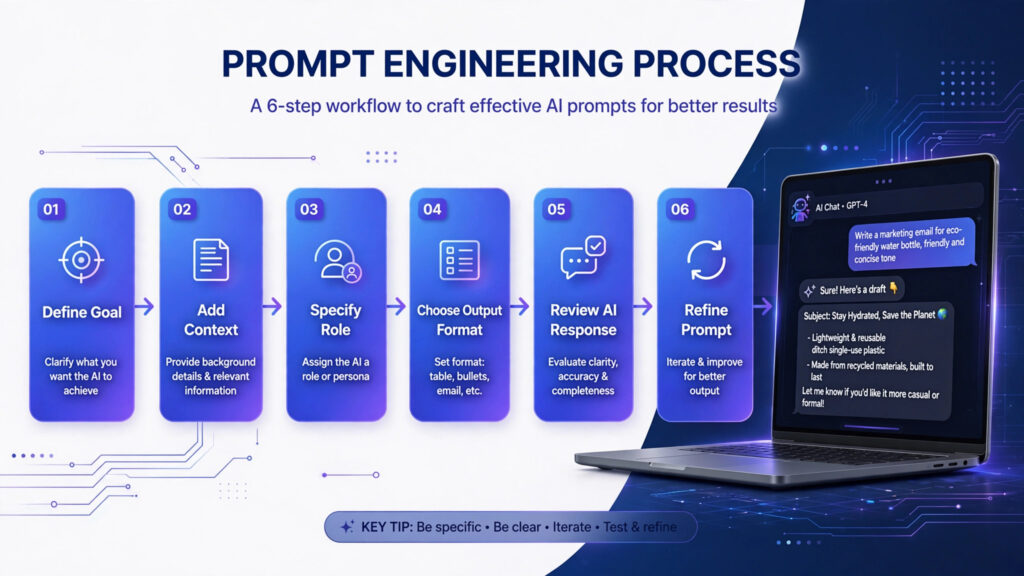
Professional prompt engineering is iterative.
Firstly, Review the output.
Secondly, Refine the prompt.
Thirdly, Ask AI to improve specific sections.
So, The second version is often significantly better than the first.
Advanced Prompt Engineering Techniques
Once you master the basics, these techniques can dramatically improve AI performance.
Assign a Role
Example:
Act as a senior SEO consultant with 10 years of experience.
This encourages AI to respond from a specific perspective.
Request Step by Step Thinking
Example:
Explain your reasoning step by step before providing the final recommendation.
This often produces more logical and detailed answers.
Use Few Shot Prompting
Provide examples before asking AI to perform the task.
Example:
Here are two examples of product descriptions. Now write a similar description for this product.
Examples help AI understand your preferred style.
Ask AI to Critique Its Own Response
Example:
Review your answer and suggest three improvements before giving the final version.
This simple technique often increases quality considerably.
Best Practices for Writing Better Prompts
By, Developing strong prompt writing habits will save countless hours over time.
Here are several proven best practices:
- Start with a clear objective.
- Provide enough background information.
- Mention the intended audience.
- Specify tone and writing style.
- Define the desired output format.
- Include examples whenever possible.
- Break complex tasks into smaller prompts.
- Review and refine your prompt after each response.
- Experiment with different wording.
- Save successful prompts for future projects.
Be Noted that: Prompt engineering improves through practice, not memorization.
How Prompt Engineering Improves Everyday Work
- The ability to write better AI prompts benefits almost every profession.
2. Writers generate higher quality articles faster.
3. Students receive clearer explanations.
4. Marketers create better campaigns.
5. Developers debug code more efficiently.
6. Business owners draft proposals and reports in less time.
7. Teachers prepare lesson plans more effectively.
Consequently, prompt engineering is rapidly becoming a core digital literacy skill rather than a niche technical ability.
Final Thoughts
Generally, AI is only as effective as the instructions it receives. Fortunately, learning how to write better AI prompts is easier than many people think. In fact, once you understand the fundamentals, you will be able to communicate with AI more effectively and, as a result, achieve consistently better results.
To begin with, by defining a clear goal, providing relevant context, specifying the desired format, and refining your instructions over time, you can dramatically improve the quality of every AI response. Moreover, consistently applying these best practices is essential because it helps you master how to write better AI prompts for both personal and professional tasks. As a result, you can save valuable time and make your interactions with AI tools more productive.
So, It is important to remember that prompt engineering is not about memorizing complicated formulas. Instead, it is about learning how to communicate clearly and effectively. Furthermore, as you continue practicing how to write better AI prompts, you will gradually develop a valuable skill that saves time, improves productivity, and helps you unlock the full potential of modern AI tools.
Therefore, start practicing these techniques today, and you will quickly notice that AI becomes more accurate, more useful, and significantly more productive in your daily work. Additionally, the more you practice how to write better AI prompts, the easier it becomes to generate high quality content, solve complex problems, and achieve the exact results you need from AI. Ultimately, effective prompting allows you to work smarter and get maximum value from the powerful AI tools available today.
Frequently Asked Questions (FAQ)
1. What is prompt engineering?
Prompt engineering is the practice of creating clear and structured instructions that help AI generate more accurate, relevant, and useful responses.
2. Why are detailed AI prompts better?
Detailed prompts provide context, expectations, and formatting instructions, allowing AI to understand your request more accurately and produce higher quality results.
3. Which AI tools benefit from prompt engineering?
Prompt engineering improves results across popular AI platforms, including ChatGPT, Claude, Gemini, Microsoft Copilot, Perplexity AI, and many image generation tools.
4. How can beginners improve their AI prompts?
Beginners should focus on being specific, providing context, defining the audience, requesting a format, and refining prompts after reviewing the first response.
5. Does prompt engineering require coding knowledge?
No. Most prompt engineering techniques involve clear communication rather than programming. Anyone can learn and apply these skills with regular practice.